
Curriculum Intent Statement
Overview
At Howard Primary School, every child is recognised as a unique individual. We celebrate and welcome differences within our diverse school community, sharing events of cultural significance to our community and, in particular, ensuring that black British history is interwoven into our curriculum. In line with the National Curriculum, we promote the Fundamental British Values that children will need to become responsible and pro-active citizens. Those Fundamental British Values include democracy, the value of a society living under the rule of law, individual liberty and mutual respect and tolerance of those with different faiths and beliefs (and for those without faith).
We place value on promoting pupil voice, encouraging all children to pursue their interests and to promote issues of importance to them. There are numerous opportunities for young people to share their perspectives on their learning journey and demonstrate their leadership skills, including School Council, Curriculum Committee, Eco Council, Year 6 Librarians, Bully Busters, Travel Ambassadors and Language Ambassadors. Our focus is to raise aspirations and engender a sense of pride in achievement, provide a purpose and relevance for learning and to ultimately allow every child to discover their strengths and interests.
Our curriculum is underpinned by a clear vision for every child to learn to embrace diversity and to demonstrate our five core values: Consideration, Courtesy, Co-operation, Commitment and Care. It is real, relevant and engaging. At the heart of what we teach is the children’s spiritual, moral, social and cultural development and understanding. These values represent both the ethos of the school and the qualities that we feel children will need to prepare them for life in and beyond primary school in our diverse society.
To access our Equalities Policy, please click here.
How we teach
| Key terms:
Core Subjects: English, Maths and Science. Foundation Subjects: Music, Art, History, Geography, RE, Computing, Design and Technology, PE, RHE, Spanish.
|
The past two years have been incredibly challenging for our pupils and so Howard Primary have worked hard to redevelop our curriculum in order to support our children in closing any gaps in their understanding, build enthusiasm for learning and to develop the skills needed to creatively and critically appraise and analyse the world around them.
Whilst English and Maths (as well as certain specialist subjects) are taught daily, Foundation Subjects are blocked into one or two week units, rather than one lesson of each subject being taught on a weekly basis. A typical timetable, therefore, would include daily maths and English, weekly RHE, Spanish (for KS2), Science and PE and then 4-5 lessons of another Foundation Subject, on rotation. From Y1 - Y6, each year group’s termly overview can be seen below. The rationale behind this structure is explained below.
Click here to view the Spring Term Curriculum map for each year group (under Curriculum tab)
How does learning take place?
Learning is a highly complex process. As educators, our role is to make learning stick, so that what we teach is committed to our pupils’ long term memory. Cognitive science splits the memory into two parts: the working memory and the long term memory.
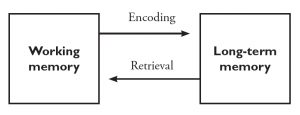
Our working memory is responsible for the intake of new knowledge, for computing that knowledge and committing it to long term memory. Our long term memory is responsible for retrieving previous information and using that to support the working memory in gaining even more knowledge.
However, it is very easy for the working memory to become overloaded, which hinders the retention of knowledge. Factors such as being provided with too much information at one time, being distracted by surroundings or things that are on your mind can all prevent children from accessing their learning. The need to remember multiple subjects in one day can, for some children, also impact this.
In order to support the process of learning, whereby knowledge is preserved in the memory long term, we plan opportunities into the curriculum for learning to be repeated, building knowledge cumulatively. Research shows that this process of interleaving, whereby depth study is spaced with retrieval opportunities at regular intervals, best supports learning. In blocking our Foundation Subjects, we are able to spend significant learning time in building connections and relating topics to previous learning, which is key to building the long term memory. Using Harvard University’s program of Thinking Routines, children are encouraged to make their thinking visible, building from each other’s ideas and understanding and enhancing their individual critical thinking skills. Over time, this enables the children to think more creatively and appraisingly, developing their procedural knowledge.
The importance of vocabulary
We recognise the importance of vocabulary and aim to ensure that children are provided with opportunities throughout the curriculum to broaden the range of language at their disposal. Bespoke vocabulary lessons are woven into our English curriculum. In addition, as well as learning a bank of topic specific terms with each unit of study, at Howard Primary we have a specific and carefully selected list of key concept terms for each Foundation Subject, which are interwoven into the children’s learning throughout their primary career. For example, the concept threads for History are:
- Democracy
- Conflict
- Immigration
- Discrimination
- Change over time
- Chronology
- Archaeology
- Innovation
Click here for link to our Concept Threads
Whichever History topic they are studying, there will be opportunities to reflect on and learn more about these key concepts and the children are encouraged to draw on previous knowledge gained, building connections and growing their web of understanding to embed this knowledge in their long term memory over time. This is the case for all Foundation Subjects.
Impact
How do we know this works? Since implementing this methodology, we have found that children are much more able to talk about what and how they are learning and are able to discuss in depth what they learnt weeks after having done so. (Evidence from pupil voice discussions and retrieval practice). This shows knowledge is embedded in long term memory. Our assessment for learning is more thorough, since teachers are able to develop a clearer picture of each individual’s understanding over the course of the block and address misconceptions more promptly, rather than waiting until the following week’s lesson. Feedback, a crucial tool in pupil progress, is able to be delivered more promptly and while the content is still fresh and in mind. Pupils have reported that they enjoy the opportunity to delve deeper into their learning over a shorter period of time. They feel that they cover more ground, the learning is more interesting, and they feel more engaged.
Foundation subject curriculum maps:
History (revised curriculum for 2021 onwards)
Relationships & Health Education (RHE)
If, after reviewing the above curriculum maps, you would like more information on our curriculum, please contact your child's class teacher or make an appointment via the Office: office@howard.croydon.sch.uk

Our pupils learn to read and write effectively and efficiently using the Read Write Inc. Phonics programme.
The programme is for:
- Pupils in Reception to Year 2 who are learning to read and write.
- Any pupils in Years 2, 3 and 4 who need to catch up rapidly.
- Struggling readers in Years 5 and 6 who will follow Read Write Inc. Fresh Start.
In Read Write Inc. Phonics, pupils will learn to:
- Decode letter-sound correspondences quickly and effortlessly, using their phonic
knowledge and skills - Read common exception words on sight
- Understand what they read
- Read aloud with fluency and expression
- Write confidently, with a strong focus on vocabulary and grammar
- Spell quickly and easily by segmenting the sounds in words
- Acquire good handwriting skills.
Please feel free to download our parent guides for more information on how to help your child to read at home: